The PDF Review Revolution: Why Email Breaks Down — and What Actually Fixes It
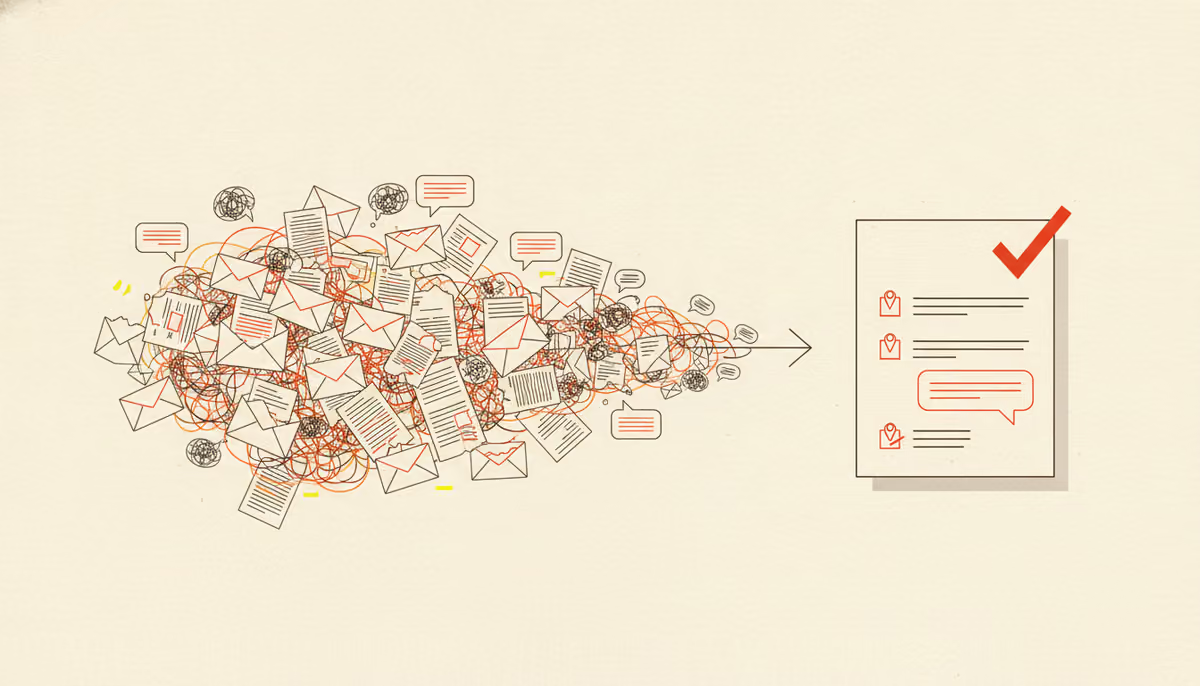
You send a PDF to five reviewers on a Tuesday. By Friday you're staring at a folder holding 'proposal_v2.pdf', 'proposal_v2_JD_edits.pdf', 'proposal_FINAL.pdf', and the inevitable 'proposal_FINAL_actually.pdf' — plus a dozen emails where the actual feedback lives. Somewhere in that pile is one comment that, if you miss it, ships an error straight to the client. Here's the part nobody warns you about: the PDF review process doesn't collapse because people are sloppy. It collapses for reasons you can predict — and once you can see the mechanism, you can stop it.
Why email review quietly collapses
Start with the arithmetic, because it's worse than it feels. Workers already spend about 28% of the workweek just reading and answering email, according to the McKinsey Global Institute — and a review piles on top of that baseline. Send one document to five reviewers and you've opened five separate conversations. Each one replies, you respond to clarify, they confirm: three messages per person before anyone agrees on anything, so fifteen emails for a single round. Add a follow-up apiece and you're north of twenty. The feedback itself is usually fine. The problem is where it lands — scattered across twenty messages in five inboxes, detached from the document it's actually about.
That detachment is the root of everything that follows. When each reviewer marks up their own downloaded copy, you don't get feedback — you get five diverging versions of the truth, and you've quietly been promoted to human merge tool. Reviewer A highlights page 3. Reviewer B rewrites the same paragraph and has no idea A touched it. Now you're reconciling conflicts by hand, two PDFs open side by side, hoping you didn't drop a single note. It's version control without any of the tools that make version control survivable.
Then there's the comment that just says 'fix the third paragraph.' Third paragraph of what — the page they're looking at, or the section? And whose page numbering, when a print layout and a screen scroll break in different places? A comment is only useful if it's anchored to an exact spot, and email quietly strips that anchor off. The reader has to reverse-engineer what the writer meant, which is how a 'quick clarifying edit' turns into a ten-minute scavenger hunt.
Boil it down, and email-based review fails in four predictable ways:
- Feedback detaches from the document — it ends up in inboxes instead of on the page.
- Versions multiply — every reviewer marks up their own copy, and you merge them by hand.
- Comments lose their anchor — 'fix the third paragraph' could point almost anywhere.
- Status goes invisible — the only place the project's real state lives is your head.
The fix: bring the people to the document
Every one of these failures has the same fix, and it's almost boring: stop shipping the document around, and bring the people to it instead. Put one PDF in one place, let everyone annotate that same copy right in the browser, and pin each comment to the exact spot it refers to. Now feedback can't detach, because it was never separate from the document. There's one version, not five. A note on page 3 stays on page 3 — as a thread you can reply to and mark resolved when it's genuinely handled. If you want the step-by-step version, here's how a review runs from upload to sign-off.
Solving the first round creates the next problem, though. You revise, send round two, and suddenly reviewers re-open points everyone already settled — or you lose track of what even changed. The honest fix is to make review rounds a first-class thing: keep the version history so 'what did we change' has a real answer, and switch on reply-only mode for the resubmission so reviewers respond to existing threads instead of carpet-bombing the document with fresh markup. The conversation moves forward instead of looping back on itself.
For anyone in legal, finance, or otherwise regulated work, the same machinery quietly solves a separate problem. Because every comment, reply, and resolution is recorded with who said it and when, you get an audit trail as a byproduct — not something you reconstruct after the fact. It's the same instinct behind a good transmittal: proof of what was sent, when, and to whom. Add encryption and role-based access over who can view, annotate, or download, and the review that used to be your biggest compliance liability turns into a defensible record.
| What happens to… | Email + attachments | In-context review |
|---|---|---|
| Feedback | Scattered across inboxes | Pinned to the exact spot on the page |
| Document versions | One per reviewer, merged by hand | A single shared copy |
| Comments | Detached and unanchored | Threaded, anchored, resolvable |
| Resubmissions | Settled points get reopened | Version history plus reply-only mode |
| Project status | Lives in your head | A dashboard with timestamped due dates |
| Audit trail | Reconstructed after the fact | Recorded automatically |
So the 'revolution' isn't magic, and it isn't really about a feature list. It's about deleting the email middleman so feedback stays welded to the document from the first markup to final sign-off — fewer versions, no lost comments, and a clear answer to 'where do we stand.' If your current PDF review process is held together by attachments and good intentions, that's the upgrade worth making — especially if you're a freelancer trying to get paid faster. You can try GoSubmit free and feel the difference on your very next review.